OFFER: A BRAND NEW SERIES AND 2 FREEBIES FOR YOU!
Grab my new series, "Brave Hearts of the Frontier", and get 2 FREE novels as a gift! Have a look here!
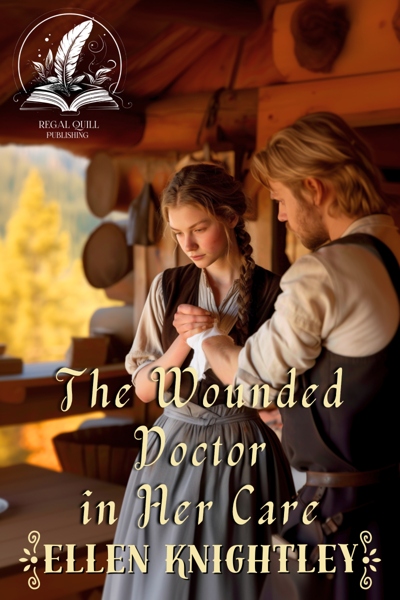 Chapter One—Amelia
The pestle moved steady in Amelia’s hand as she ground dried yarrow into a fine, pale dust. The rhythm was familiar—press, turn, gather. It kept her thoughts quiet, her focus where it belonged.
A thin line of morning light stretched over the hills beyond the cabin window, muted and cold. The air still held the night’s chill, slipping through the cracks in the wood. Smoke curled slowly from the stove, carrying the scent of pine and sage hung drying from the rafters overhead.
Out here in the Montana Territory, there was no doctor for miles—only what a person knew, and what they could carry in their hands. It was 1885, and folks out this far didn’t wait on help that might never come.
Amelia knew the room by feel. The jars were where they ought to be, the cloths folded, water already set to warm.
Everything in its place.
She’d rolled her sleeves past her elbows, forearms dusted with powder. A strand of ash-brown hair had slipped loose from her braid, brushing her cheek.
The world was quiet and steady in the way Amelia knew well.
A hard pounding struck the door, sharp enough to rattle the hinges. Amelia’s hand stilled on the mortar. Another blow followed, urgent and uneven, breaking the morning calm.
She set the pestle aside and cleared the table with one sweep of her arm—cloths pushed back, jars shifted to make space, and she opened the door.
A man staggered in, breath ragged, boots tracking dirt across the floor. He clutched a boy tight against his chest, the child’s face buried against his shoulder, a thin, broken cry slipping free.
“Miss Dawes—please—”
“Lay him here. Easy now,” Amelia said, pointing at the table. She stepped in close, already studying the child. “What happened?”
“Lantern—he knocked it over—” The man swallowed hard, shifting the boy in his arms. “The fire caught his arm—”
Amelia pushed back the boy’s sleeve. The skin was red and blistering along his forearm, heat still rising from it.
“How long ago?”
The man hesitated, his eyes darting over the shelves, the jars and the herbs hanging from the rafters.
“You—you can fix it, can’t you?”
“I can help,” Amelia said firmly. “When did it happen?”
“Just now, minutes ago—”
“It’s good you came soon,” she said. “We’ll tend to it properly.”
The boy whimpered and tried to pull away, but Amelia gentled her grip without letting him go. “You’re all right. Stay with me, son.”
He looked up at her with wide, wet eyes.
“Look at me,” she said quietly. “That’s it.”
Her hands didn’t shake.
Behind her, her sister Charlotte—her twin in face if not in manner—had joined them and she was already moving, lifting water and gathering cloths without instruction.
Amelia reached for the basin and dipped a cloth into the water. She wrung it out once.
“Hold him steady,” she said.
The father moved, bracing the boy’s shoulders, but his eyes were wide with worry, and his hands trembled lightly.
Amelia ignored that. Trembling didn’t help anyone.
She pressed the cloth gently to the burn.
The boy gasped but he didn’t cry or pull away. The heat began to draw out under the cool cloth.
“That’s it,” Amelia murmured. “You’re very brave. Look at me.”
His breathing hitched, but he looked at her, doing what he was told. His lower lip quivered but he bit back his tears.
Carefully, Amelia shifted the cloth, cooling the skin without dragging against it. The angry red began to dull, just a little.
Behind her, Charlotte set another basin on the table and moved to Amelia’s side. In the low morning light, she might’ve been Amelia’s reflection at a glance. She had the same ash-brown hair and the same warm eyes. Only, where Amelia held stillness, Charlotte carried ease.
“Charlotte, the salve, please.”
Charlotte reached for the shelf.
Amelia didn’t look back. “Not that one—the stronger mix.”
A moment later the right jar was placed in her hand.
They didn’t need to say more.
Amelia set the cloth aside and opened the jar. The scent rose up—sharp comfrey, a hint of lavender, something bitter underneath. The salve was thick and dark as it clung to her fingers.
“It’s gonna feel strange,” she told the boy. “But it’ll help.”
He nodded, biting on his lip.
She spread the poultice over the burn in slow, even strokes. The texture was sticky, cooling as it settled into the damaged skin. The boy flinched once, but he held his arm steady for her.
“See?” she said softly. “Not so bad.”
Charlotte passed her a clean strip of cloth before she asked for it. Amelia wrapped the arm with practiced care, making sure it was secure but not too tight, leaving space for the swelling.
The boy’s breathing had eased a little and he wasn’t crying anymore.
Amelia rested her hand briefly over his wrist, feeling the pulse.
Steady.
She leaned back just slightly and smiled at the boy’s father, who let out a breath of relief.
“Is he goin’ to be okay?”
“He’ll be sore,” Amelia said, already reaching for another cloth to clean her hands. “But he’ll mend. Keep it clean and bring him back tomorrow. I’ll change the dressing.”
The man nodded fast.. “You’re a godsend, Miss Dawes.”
“You’re always welcome,” Amelia said and rinsed her hands, watching the water cloud with herbs and ash.
Behind her, Charlotte adjusted the boy’s coat over his shoulders.
The room fell quiet again.
For now.
The boy had gone quiet, his head resting heavy against his father’s shoulder now, eyes half-lidded with exhaustion.
Amelia adjusted the edge of the bandage one last time, checking the wrap sat right. No slipping. No pressure where it shouldn’t be.
“That’ll do,” she said. “Keep him from fussin’ with it. Bring him back sooner if the skin swells too much or he takes fever.”
“I will. I surely will.”
He shifted the boy carefully into his arms again, holding him closer now, like he didn’t quite trust the world not to hurt him again.
Amelia stepped back.
“Thank you,” the man said again. “I don’t know what we’d have done without you.”
“You came soon enough,” she said. “That’s what matters.”
He nodded.
“I’ll bring eggs by,” he added quickly. “Soon as I can. Maybe some milk too.”
“That’s not necessary,” Amelia said, drying her hands with a clean cloth.
But he shook his head. “No, miss. It is.”
She didn’t argue. Folks gave what they could. That was the way of it.
He lingered a moment longer, shifting his weight, like there was something else pressing at him.
Then, almost as an afterthought, he said, “Town’s gettin’ a proper doctor soon, they say.”
Amelia’s hand stilled, just for a second, the cloth momentarily motionless.
Behind her, Charlotte went quiet too.
“From back East,” he went on. “Philadelphia, I heard. Real trained man.”
Amelia hung the cloth to dry.
“A doctor,” he added, giving a small, hopeful shake of his head. “Imagine that. Someone folks can trust proper,” he said. “With training and all.”
There was no malice in his voice, just a simple inevitability.
Somehow, that made it worse.
“Is that so,” she said flatly.
“Sponsored by Charles Whitaker, they say,” the man continued. “Should be good for the town. Folks been talkin’ on it all week.”
Amelia nodded once, like it didn’t matter either way.
“Safe travels,” was all she said and it was enough to send him on his way.
He thanked her again and stepped out into the morning light. The door closed behind him with a dull sound before silence returned to the cabin.
Amelia turned back to the table, picking up the jar she’d left open. The lid of the salve jar slipped once in her hand before she caught it, steadying it with a firmer grip. Charlotte didn’t say anything yet and the quiet between them stretched.
She put the jar back on the shelf where it belonged. All her equipment and herbs were in order, as it always was.
But it didn’t feel the same anymore.
Charlotte gathered the used cloths into a basin. “You hear what he said,” she said.
Amelia picked up another cloth, though there was nothing left to clean, and folded it once, then again.
“I heard.”
Charlotte didn’t move closer. “And?”
Amelia set the cloth down with care, smoothing the edge of it with her palm.
“Folks say a lot of things.”
Charlotte didn’t let it rest. “Not like this,” she said. “Not something that could take your place.”
Her tone stayed level and easy like it didn’t matter at all.
Amelia didn’t answer.
Charlotte studied her a moment longer, then crossed to the table, setting the basin aside.
“Philadelphia, he said. That’s a long way to come.” Charlotte went on, softer now.
Amelia picked up the pestle and set it into the mortar. She turned it once, though there was nothing left to grind.
“Maybe he’ll change his mind about coming all the way out here,” Charlotte added, keeping up the conversation even if Amelia didn’t join in. “Or maybe folks will decide he knows better.”
Amelia let out a quiet breath through her nose.
“Maybe. We don’t have anything to worry about, I’m sure. We can use all the help we can get around here. We never turn help away.”
She was trying to sound convincing, but she could hear the lack of confidence in her own voice.
Charlotte’s gaze softened, but she didn’t press further.
Amelia set the pestle down again and wiped her hands on her apron, even though they were already clean.
The cabin looked just as it had before—table cleared, tools in place, fire steady. Nothing out of order.
Only the quiet felt heavier, now.
Amelia reached for the basin to empty out the dirty water and fill it with clean.
“Leave that,” Charlotte said gently. “I’ll take it.”
“I’ve got it.”
Charlotte hesitated a moment, then let go.
Amelia carried the basin to the washstand and emptied it out before she filled it with clean water, ready for the next patient who might need their help.
Charlotte stayed by the stove, watching her. “You don’t seem bothered.”
Amelia moved the basin back to the table so that it would be ready. “That’s enough,” she said. “I’ve got work to do.”
Behind her, Charlotte stirred the pot on the stove, though it didn’t need stirring.
Amelia crossed to the line near the window, hanging the used cloths to dry. She smoothed each one flat, pulling the edges even.
Then she stepped back and looked over the room. The table was cleared. The shelves set. The fire steady, just as it had always been.
Charlotte shifted her weight. “Amelia—”
“I said it’s fine.”
It wasn’t sharp, but it was firmer now—enough to end the conversation.
Amelia reached for the mortar again, turning it slightly so it sat square against the edge of the table. She stood there a moment, her fingers resting against the stone.
Charlotte crossed to the shelf and reached for a bundle of dried chamomile, fingers brushing the brittle stems loose. “We’re near out of this,” she said, like nothing at all had changed.
Amelia stepped beside her, taking the bundle and setting it on the table. “We’ll need more before the week’s through.”
“I can gather some this afternoon.”
Amelia nodded. “Near the creek. The patch there’ll be ready.”
Charlotte smiled. “You always liked that spot better.”
“It grows stronger there.”
They fell into it easy after that, going through the motions.
Sorting. Stripping leaves from stems. Setting aside what could be used, what needed drying longer.
Their hands moved in rhythm—one passing, the other taking without need to ask or explain.
This was how it had always been.
Charlotte nudged a small pile toward her. “You remember how Pa used to say chamomile was for folks who worried too much?”
Amelia huffed a quiet breath. “He said it was for folks who wouldn’t admit they were worried.”
Charlotte grinned. “That too.”
Amelia’s fingers stilled for a moment over the herbs.
Pa’s voice came back clear as anything. The way he used to hum under his breath while he worked, like the whole world made sense so long as his hands were busy.
They had learned it all right here, at this table—watching, doing, listening, until the work had taken root in their hands as naturally as breathing.
Charlotte glanced over at her. “You’ve helped more folks than any doctor could.”
Amelia kept her eyes on the herbs, separating the good leaves from the dry ones with steady fingers. She cleared her throat and reached for another bundle, her movements a little sharper now. “Hand me the twine.”
Charlotte passed it over, but she didn’t let the moment go. “You ever think Pa would’ve wanted more for you?”
Amelia tied off the bundle neatly. “He wanted folks cared for.”
“He wanted you happy too.”
Amelia didn’t answer.
Charlotte studied her, then her expression shifted—lighter, a spark of mischief creeping in the way it used to when they’d taken advantage of being identical. “You remember the time we swapped places on old Mrs. Hargrove?”
Amelia blinked, caught off guard.
Charlotte grinned wider. “She scolded you for not mindin’ your manners—only it was me standin’ there the whole time.”
Amelia let out a short laugh before she could stop it. “You near got us both turned out for that.”
“Worth it,” Charlotte said. “You should’ve seen your face when Pa figured it out.”
Amelia shook her head, a faint smile tugging at her mouth. “He knew the whole time.”
“He still let us try,” Charlotte said softer. “Said it built character.”
“Said it built trouble,” Amelia corrected.
They laughed together.
For a moment, it felt like nothing had changed at all. Like the years hadn’t moved. Like their father might walk through the door any second, shake his head at the mess, and set them both back to work.
Amelia turned back to the herbs, tying off another bundle.
It was the same table, the same work, the same life.
She held onto that a little tighter than before.
When the last of the bundles were tied and set aside, she cleared the table again, returning everything to its place.
Charlotte gathered the last of the loose stems into a basket, brushing her hands together. “That’ll do for now.”
Amelia nodded, though her hands didn’t quite steady. She wiped them against her apron, then turned toward the window.
The sun had climbed higher as they’d worked. The pale dawn had stretched into morning, laying gold across the land beyond the cabin. The hills rolled wide and open, grass bending soft under the breeze.
It was familiar—all of it.
Charlotte followed her gaze. “You could stay, you know.”
Amelia didn’t look at her. “I am stayin’.”
“That ain’t what I meant.”
Amelia’s jaw tightened as Charlotte stepped closer.
“You’re needed here,” Charlotte said, quieter now.
Amelia let out a slow breath. “I know.”
She knew every trail, every family, every door she’d ever stepped through with her satchel in hand. She knew who paid in eggs, who paid in firewood, and who couldn’t pay at all.
She knew where she belonged.
Still, her eyes stayed fixed on the horizon.
“There’s more out there than this town,” she said.
Charlotte went still.
“People who don’t have anyone.”
Charlotte studied her. “And you think they need you more than we do?”
Amelia shook her head once. “That ain’t it.”
“Then what is it?”
Amelia hesitated, just long enough to feel it—that restlessness she didn’t like to think about. The sense that what she knew, what she’d been taught, might not be enough.
“That don’t mean I should stay,” she said finally.
Charlotte didn’t answer right away. Outside, the wind moved through the grass in a low, steady hush.
“You’ve got a place here,” Charlotte said at last. “You always have.”
Amelia’s gaze was drawn outward like she was searching for something she couldn’t quite see.
Behind her, the room stayed warm—ordered and sure, holding all she knew, what she’d built, and the responsibility her father had left in her hands.
She turned back slowly, her eyes drifting across the table, the shelves, the rows of jars set just right.
Her work. Her place. Her life.
The thought came quiet. Simple. Unwelcome.
If the doctor comes… where does that leave me?
Chapter Two—Samuel
Samuel Whitaker eased his horse along the riverbank, the animal’s hooves striking a steady beat against the packed dirt. Morning light stretched across the Montana Territory, pale gold over water that moved slow and cold beside him. It had been years since he’d last ridden this stretch.
The land looked smaller than he remembered. The hills were less wild, the river narrower in its bend. Time had a way of doing that, he supposed—shrinking things that once felt endless.
He shifted slightly in the saddle, rolling one shoulder back beneath his coat. Dust clung to the dark wool, the hem worn from days on the trail. He hadn’t stopped longer than necessary since leaving the rail line. There’d been no sense in it when there was work waiting.
His grip on the reins stayed steady, controlled, though the horse beneath him could feel the long journey just as well. They’d both pushed hard to make the distance.
“Not much farther now,” he muttered.
He kept his eyes ahead, scanning the rise beyond the river. The land should turn there—he remembered that much. A ridge, then the road cutting east toward town, toward the Whitaker place.
He straightened slightly at the thought, posture tightening without effort.
He’d pictured this return more than once over the years. Not the road or the river, but the moment itself—arriving not as a boy trailing behind expectations, but as a doctor—trained, capable, and ready.
Samuel exhaled slowly through his nose, steadying himself as the memory settled into something familiar and weighty.
Charles Whitaker, his adoptive father, would expect nothing less than perfection and Samuel had always risen to that standard. He’d been taken in young and raised under that expectation until it became something permanent.
Samuel adjusted the reins, guiding the horse up a shallow incline. The ground shifted beneath them, looser here, scattered with stone and dry grass.
The air carried the scent of dust and early sun-warmed earth. No city noise. No close walls. Just open land and distance in every direction.
It should’ve felt like coming home, but something it didn’t; something seemed just slightly off.
Samuel frowned, eyes narrowing as he looked ahead again, measuring the land against memory. He’d been sure of the way. Only now, the ridge didn’t sit quite where it ought to be.
He slowed the horse just a fraction, easing back on the reins. No need to rush it, it was better to be sure.
The cabin came into view just past the bend.
Samuel slowed his horse without thinking. It sat close to the river, tucked low against the land like it had grown there instead of being built. Nothing grand about it—plain timber, weathered some, roof sloping honest against the wind.
It was practical and clearly lived-in.
Samuel’s attention narrowed slightly as he took in the details, his gaze shifting to the ground around it, where the land had been worked carefully.
There were no crops—not in the way most folks did it—but something more deliberate. Rows, but not neat in the rigid sense he was used to seeing back East. These followed the land instead of fighting it, curved with the slope, spaced with intention.
An herb garden.
Samuel drew the reins in just a touch more, and studied it.
He recognized some of it—feverfew, maybe, and something that looked like yarrow—but not all. Not arranged the way he’d been taught, either. It wasn’t decorative, it was ready for use.
His gaze moved slowly across the space, taking in the small details—the way sure plants were grouped, the clear paths between them, and the signs of recent tending.
There was order to it. Quiet, steady, and intentional.
He creased his brows as he took it in.
The door opened, and a woman stepped out onto the porch, carrying a basin. She moved , setting it down near the railing before straightening. Her sleeves were rolled to the elbow, her dress plain and practical, the fabric worn in the way of something used daily, not kept for show. Her hair was pulled back simply, no effort made to dress it finer than needed.
Samuel didn’t know her.
There was nothing remarkable about her at first glance, but Samuel found himself watching her. He took in the way she stood and the way she looked out across the land with awareness, as if she took stock of everything around her.
As if she knew the land and exactly what she was looking for.
Samuel guided his horse closer, the animal’s pace slowing to a careful walk as he approached the cabin. Gravel shifted under hoof enough to draw attention.
The woman turned her head to him and her gaze settled on him. For a brief moment she didn’t speak. She looked at him the way a person might look at a problem set before her—measuring instead of reacting.
Samuel felt it. That pause. That quiet assessment.
He straightened slightly in the saddle and touched the brim of his hat.
“Ma’am,” he said, voice even. “I was hopin’ to trouble you for some water.”
Her eyes flicked once to the canteen at his side, then back to his face.
“You’ve come a fair distance?” she asked.
Samuel gave a short nod. “Far enough.”
Another brief pause passed between them before she stepped aside, reaching for the basin she’d set down earlier.
“You can fill it there.”
“Much obliged.”
He swung down from the saddle in one smooth motion, boots hitting the ground with a dull thud. He landed straight despite the long ride—tall and lean, his posture refined in a way the frontier rarely demanded. Dark blond hair fell slightly out of place from the journey, and his clear blue eyes took in everything with quiet precision. His coat, though dust-worn, still held its structure, and there was a control to his movements that spoke of training rather than habit.
He crossed to the basin, crouching just enough to fill his canteen. The water was cool and clear.
He capped his canteen, rising again, and hesitated only a moment before adding, “I may’ve taken the wrong crossing.” The admission sat uncomfortable between his ribs. “Whitaker place still east of here?”
She studied him again. “You passed it.”
Samuel furrowed his brow.
She nodded once toward the ridge behind him. “You’ll need to double back along the rise. Road cuts through just beyond it.”
Samuel glanced in the direction she’d indicated, then back at her. “That so.”
“You missed the turn near the split cottonwood,” she added. “Easy to do if you don’t know it.”
The words settled under his skin.
“I see,” he said.
For a moment, neither of them spoke. The air sat still between them, the river moving quiet behind the cabin. She didn’t offer more, she just waited for him to say something else.
Samuel gave a small nod. “Appreciate the direction.”
Her gaze held his a second longer, still measuring, before she inclined her head.
He turned back to his horse.
She’d spoken like she knew the land better than he did. She knew the place he’d always called his home better than he did, and what unsettled him most was that she might.
Samuel mounted again with practiced ease, settling into the saddle and gathering the reins in one controlled motion.
He nudged the horse forward, guiding it back the way he’d come. Despite himself, he looked back but she’d already bent down again, her attention on something else.
He turned his focused onto the land ahead, on the rise she’d pointed out, measuring distance and direction against what he thought he remembered. The ridge did sit where she’d said—subtle, easy to miss if a man rode too fast or assumed too much.
He adjusted his course, turning along the rise.
It felt like a strange sort of welcome, not knowing the world he’d left behind.
He exhaled through his nose, eyes narrowing against the morning light. He hadn’t expected to be corrected before he’d even arrived. He shifted in the saddle, rolling his shoulders back as if to shake it loose.
It shouldn’t matter. He’d asked, and she’d answered and it had been an easy mistake to make. That was all.
He slowed the horse as the ridge came into clearer view, guiding it along the path she’d described. The turn revealed itself soon enough—a narrow cut through the rise, worn by use. There was no marked sign.
He’d missed it—a small thing, easily corrected.
Still, he found himself thinking of the cabin again. The garden. The way everything there had been set with quiet purpose.
And her, the way she’d looked at him—measured and unimpressed.
Samuel adjusted the reins, urging the horse forward.
The Whitaker house came into view over the final rise.
Samuel slowed his horse as he approached, taking it in.
It stood larger than anything nearby—two full stories, clean lines, the structure firm and symmetrical in a way most places out here weren’t. The wood was well-kept, the windows evenly set, the fence running straight along the property as if it had been measured twice before being laid.
The place was ordered and intentional, with nothing left to chance.
A stable sat off to the side, already stirring with movement—men at work, wagons set in place, everything running as it should.
Samuel straightened in the saddle without thinking.
This order was what he’d come back to, what he was expected to step into.
Before he could dismount, the front door swung open.
“There he is!”
Charles Whitaker’s voice carried across the yard, loud and sure, as the man strode out onto the porch. He came forward like he owned the ground between them. He cut a striking figure even from a distance—silver threading through dark hair, his coat finer than any man in town had reason to wear, every inch of him polished and precise.
“Just like I said—best-trained man this territory’s seen!”
The words rang out, meant for more than just Samuel. A ranch hand paused near the fence and another turned from the stable.
Samuel swung down from the saddle, landing steady once again. He removed his hat, holding it at his side.
“Sir.” The word came out of habit, not affection.
Charles clapped a firm hand to his shoulder before he could say more, the same way he had since Samuel was a boy. Approval was given more for performance than anything else.
“Look at you,” Charles said, stepping back just enough to take him in. “Cleaned up proper, my boy. The city’s done you good.”
Samuel gave a small nod. “I’ve done what I could with it.”
“That’s what I like to hear.” Charles turned slightly, gesturing toward the house, the yard, everything.
“This town’s been waitin’ on you whether it knows it or not. Don’t disappoint me now.”
The weight of those words settled quickly—expectation, pride, and something closer to pressure beneath it. Samuel kept his posture steady, his expression controlled. “I intend to be of use.”
Charles grinned at that. “Oh, you will be.”
There was no doubt in his voice.
Samuel glanced past him toward the house again, taking in the straight lines, the ordered space, the sense that everything had already been decided before he’d even stepped inside.
Behind him, the land stretched wide and unbound but ahead, everything narrowed.
“Go on,” Charles said. “Take care of your steed and we’ll talk later.” He walked back to the house, already dismissing Samuel.
Samuel turned toward the barn.
This was where it began. This was where he proved himself.
The stable doors creaked open as Samuel led his horse in, the familiar scent of hay and leather settling around him. It hit him sharper than he expected—memory tied to something solid, something known.
“About time you made it back.”
Samuel turned at the voice.
Jacob Barton stepped out from the far stall, wiping his hands on a cloth. He was broad-shouldered and sun-worn, dressed like a man who belonged to the land more than the house it served.
He’d been at Whitaker’s side for years—foreman, friend, and the closest thing to steady truth Samuel remembered from boyhood.
Samuel gave a short nod. “Took the long way.”
Jacob’s mouth twisted into a grin. “Looks it.”
Samuel handed off the reins, and Jacob took them without ceremony, moving to check the horse over with practiced ease.
“Good to have you back,” Jacob added.
Something in that landed differently than Charles’s welcome had.
Samuel nodded once. “Good to be back.”
Jacob didn’t press further.
The moment eased between them—familiar in a way Samuel hadn’t realized he’d missed. He stayed in the stable as long as he could but he couldn’t hide out in there forever, and finally he walked to the house.
A door to the side opened as he drew closer.
“Well, there you are.”
Martha Howell, the Whitaker’s housekeeper who had raised him as much as anyone had, stood in the doorway to the house. She had one hand braced against the frame, the other already reaching for him before he’d stepped toward her. Her gaze moved over him quickly and thoroughly, taking in every detail.
“You look worn clear through,” she said.
Samuel smiled. “It’s been a long road.”
“That it has.” She stepped closer, brushing dust from his sleeve like she had any right to it. “Come on in before you fall where you stand.”
He allowed himself to be guided inside, stepping over the threshold as the door shut behind him.
The shift was immediate. The air was cooler, the lines cleaner, everything set in its proper place.
Martha paused just long enough to look at him again, her expression softening. “We kept your room as it was.”
Samuel inclined his head. “Thank you.”
Jacob stepped in behind them, quieter now, the weight of the house hanging over him differently than it had in the barn.
For a brief moment, Samuel felt it—something close to belonging. Familiar ground, familiar faces, a place he knew how to understand.
But it didn’t feel the same way it used to.
He didn’t stop in the front room.
“Martha—how is she?” he asked, already turning toward the staircase.
Martha’s expression shifted, the warmth softening into something more careful. “She’s been resting. Some better this morning.”
“Some,” Samuel repeated.
It wasn’t enough. He moved for the stairs, taking them two at a time before catching himself and slowing near the top. No use arriving breathless or looking unsure.
He steadied his pace.
The hallway was quiet, the air faintly scented with lavender, something medicinal beneath it. A door stood half-open at the far end.
Agnes stepped out just as he approached. She was a maid, young and soft-spoken, her hands still damp from whatever task she’d left behind.
She paused when she saw him, relief crossing her face quick and unguarded. “Dr. Whitaker.”
“Just Samuel,” he said evenly. “How is she?”
“She’s been resting,” Agnes said, lowering her voice. “Weak, but no worse through the night.”
Samuel nodded once. “May I?”
“She’ll want to see you.” Agnes stepped aside.
Samuel pushed the door open and stepped inside.
The room was dim, curtains drawn to soften the morning light. His adoptive mother, Eleanor Whitaker, lay propped against the pillows. Her frame was slight beneath the blankets, her face ashen with a fragility that spoke of long illness rather than sudden weakness.
Even resting, there was a carefulness to her breathing, as if each breath had to be considered before taken.
For a moment, he simply stood there.
Not a doctor yet, just him.
He remembered very little of the parents he’d lost—only fragments. A voice, a hand, the faint scent of herbs his mother used to keep near the kitchen window.
She stirred at the sound of the door, her eyes opening slowly. It took her a second to focus, and then she saw him.
“Samuel.” Her voice was weak.
He crossed the room at once. “I’m here.”
Something in her expression eased at that, the tension leaving her shoulders as she reached for his hand. He took it carefully, mindful of her strength—or lack of it. Her skin was too cool and far too thin beneath his fingers.
“You’ve come home,” she said.
“Yes, ma’am.” He’d never called her anything else.
Her grip tightened faintly. “You look… older.”
He allowed himself the smallest hint of a smile. “That tends to happen.”
She studied him a moment longer, as if she was measuring something deeper than what could be seen. Then she nodded, satisfied enough.
“You’ll do well here,” she said quietly.
Samuel inclined his head. “I intend to.”
She closed her eyes briefly, still holding his hand, as if that was enough for now.
Samuel stood there a moment longer, listening to her breathing. It was steady, but shallow and that worried him.
He could help her. He would. That was the point of all of this—the reason he’d come back.
He released her hand carefully and stepped back, his focus already sharpening, shifting toward proving he could do what needed to be done.
He turned for the door.
The hallway felt narrower on the way out. Samuel paused at the top of the stairs, one hand resting briefly against the railing.
He’d made it back. The house, the expectations, the work—all of it was exactly as it should be.
This was where he belonged. It was what he’d been raised for.
Still, his gaze drifted, unfocused for just a moment, and without warning the image came back—the cabin by the river, the ordered rows of herbs, the woman standing on the porch, watching him like she already knew something he didn’t.
Samuel’s jaw tightened slightly.
Strange, that she’d be the first thing that unsettled him.
He pushed the thought aside and started down the stairs.
He’d come back to prove he belonged and already, that belonging didn’t fit the way it should have.
OFFER: A BRAND NEW SERIES AND 2 FREEBIES FOR YOU!
Grab my new series, "Brave Hearts of the Frontier", and get 2 FREE novels as a gift! Have a look here!
Hello my dears, I hope you enjoyed the preview! I will be waiting for your comments here. Thank you 🙂