OFFER: A BRAND NEW SERIES AND 2 FREEBIES FOR YOU!
Grab my new series, "Brave Hearts of the Frontier", and get 2 FREE novels as a gift! Have a look here!
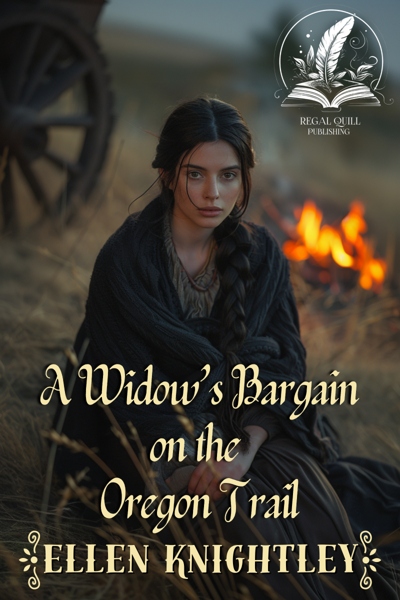 Chapter One
When Ada Lockwood woke, she dared not move.
She held her breath against the sick feeling clawing her throat. The temptation to gag was almost overwhelming, but Ada breathed slowly and didn’t stir. If she moved too quickly and woke Fletcher …
Then a hoof stomped, the sound disconcertingly close, and Ada’s eyes popped open.
Of course. There was no Fletcher to fear anymore.
She supposed that the flood of relief rushing through her was an ugly thing, but she couldn’t stop herself from feeling it as she raised her hands above her head and stretched from her fingertips to her toes. Her muscles ached from a long night on hard ground with only the sheet of canvas and pile of wool blankets from her bedroll to shield her, but the stretch felt glorious.
Then the nausea returned, stinging the inside of her throat, catching the back of her jaw. Ada rolled from her bedroll and staggered upright. The bedrolls arranged within the circle of wagons were largely motionless, and nobody stirred as she stumbled from her bedroll, crashed through the grass behind her wagon, and doubled over, sick.
Last night’s hardtack made a painful reappearance. Ada clung to her wagon’s wheel, which braced against a rock, for support with one hand. She kept her hair out of her face with the other.
This was the third day she’d woken up sick like this. The nausea had built slowly, starting when they’d left Independence. Was it the river water? The constant rocking of the wagon? The change in food?
A deep nicker interrupted her thoughts. Two mules stood nearby, their long ears pricked toward her in anticipation of breakfast.
“Yes, yes.” Ada sighed. “I’m coming.”
The sounds of camp began to stir around the smoldering remnants of last night’s fire. Ada’s mules weren’t the only ones seeking their morning grain. Several other animals stirred on the picket lines surrounding the camp as folks began to rise from the bedrolls. Yawns and sleepy greetings mingled with the shuffle of hooves and the creak of ropes.
Nobody called out to Ada, nor did she respond. She kicked some dirt over the evidence of this morning’s illness and clambered into her wagon. Barrels, sacks, and ropes crowded the only piece of furniture she’d been able to bring from the farm in Independence: a sturdy wooden trunk, once the hope chest that Aunt Temperance had so lovingly sent to her.
Hope chest. The thought was bitter now, in the wake of everything that had happened. Aunt Temperance must have hoped for a far different outcome than this one. Maybe she imagined a loving husband and a house full of children. Certainly not a woman alone on the Oregon Trail just a few short years later.
Ada shuddered and thanked God that there had never been any children.
She scooped grain from one of the sacks nearest the back of the covered wagon, its canvas stirring in the morning breeze. The mules nickered again as she tipped the grain into their nosebags.
Somehow, those scoops of grain seemed to have gotten heavier over the past three weeks. Ada had fed these mules every morning and evening for months, yet now her arms ached with the effort as she used a stool to get down from the wagon and moved over to the picket line.
The word cholera briefly flashed through her mind like a curse. She dismissed it. The monster that had taken her parents had killed them in mere days. If she had contracted cholera, she’d be dead by now.
The older mule, Margaret, pinned her ears at the younger and held out her soft white nose for breakfast. Ada looped the leather nosebag’s strap over her ears. The younger, Jane, hung back until Margaret was happy before she accepted her own nosebag. Rope halters secured them to a length of rope Ada had stretched between two pickets on the ground the night before; Jane kept well to her end of the rope, avoiding Margaret’s twitching haunches.
“Maggie,” Ada snarled when Margaret swung her quarters nearer.
The warning worked. The older mule skittered temperamentally to the other side of her line.
Ada rubbed her face, fighting another wave of nausea. She didn’t have time for this. Around the campfire, folks were already rolling up their bedrolls, chewing salt pork for breakfast, and shouting at their children to help with harnessing their animals.
“Hot day ahead, folks.” Captain Mercer’s voice cut across the campsite. “Best get movin’.”
Ada left the mules to eat. She had salt pork and dried peaches in the wagon, but the thought of them turned her stomach. Even brewing a cup of coffee made her gag. She sipped it slowly as she secured her bedroll and tossed it into the wagon.
She abandoned the coffee when the mules finished their grain. After taking off their nosebags, she threw the heavy harnesses over their strong bodies and began to secure the dozens of straps.
“Need any help there, Ada?”
Ada stifled a groan and forced a smile in place as she turned to face the older woman standing behind her. Mrs. Holbrook had her hands folded over her pretty white apron with its perfect laced edges. A symmetrical bow secured her bonnet under her chin, and she tilted her head to the side, her smile as sweet as honey.
“I’m all right, thank you, Mrs. Holbrook,” said Ada politely.
“Are you sure, honey? Why, it’s an awful lot of work, harnessing a pair of mules. Hardly the type of thing that most women would think to undertake alone.”
“I’ve done this plenty of times in the past few weeks.” Ada tightened Margaret’s girth and dodged a kick from the cantankerous old mule.
Mrs. Holbrook tutted her tongue. “I’m afraid you have, haven’t you? What an awful thing, to see a woman struggling all on her own like this.”
Ada gave a tight-lipped smile and settled the crupper over Jane’s haunches.
“Some would even say,” Mrs. Holbrook continued, still sweet as could be, “that it’s not proper, a woman all by herself like this.”
Ada spun around, searching the older woman’s eyes. “Are you accusing me of something?”
“Accusing? My dear, of course not. I’m only saying that some widows would behave differently.”
Ada clenched her jaw.
“How long has your dear husband been gone?” Mrs. Holbrook asked.
It wasn’t any of her business, but Ada had been raised to respect her elders. “Two months.”
“Poor, poor man. I’m so terribly sorry. What did you say had happened to him?”
“A stagecoach accident.”
“Oh, how awful!”
“It was a terrible shock,” said Ada, a hint of sincerity reaching her tone. Fletcher’s death had been many things, but a shock was certainly one of them. “He was young … I never thought this would happen.”
“You poor, sweet soul. Were you married long?”
“Eight years.”
Mrs. Holbrook’s eyes narrowed. “Yet you say the Lord saw fit never to bless you with any children.”
“His plan is always good.” Ada firmly believed it—especially when it came to this. Children with Fletcher in the house? It would have been unthinkable.
“Amen, my dear girl. Amen.” Mrs. Holbrook patted her arm, but her eyes were distant. She studied Ada for a few more moments before her husband called for her, and she hurried away.
Ada sighed as she backed Margaret and Jane into place on either side of the wagon’s tongue and attached the long pole to their traces. Mrs. Holbrook’s questions had come under the guise of neighborly caring, but she couldn’t shake the feeling that the older woman had been interrogating her.
As though she didn’t fully believe Ada’s story, or her motives for tackling this trail all on her own.
***
Nebraska’s endless prairie lay unrolled to the distance like a gigantic carpet of brown and green. The flatness was nearly depressing, with only the occasional undulation as the ground sloped toward the trail that followed the sprawling course of the Platte River. For someone used to the hills of Missouri, there were days when the prairie felt unending, as though the entire world had become nothing but horizons.
Ada tried not to stare into the distance. She fixed her eyes on the mules’ ears instead, watching as the patient animals plodded along in the dust cloud left behind by the other wagons. Margaret occasionally pinned her ears at Jane, who meekly kept her head low, tail swishing nervously.
“Maggie, cut it out,” Ada commanded.
Margaret snorted.
The wagon train stretched along the trail ahead, a couple of dozen strong, their white covers making them look like a herd of sheep bobbing across the prairie. A small herd of livestock lumbered in the middle. Riders along the front, back, and sides kept everyone in line, though Ada noticed few horsemen bothered to come by her wagon near the train’s rear.
Jane tipped an ear at a shadow and skittered sideways, almost bumping into Margaret. The older mule squealed and nipped at her.
“Stop that!” Ada commanded.
Jane swiftly settled down after Margaret’s discipline. Ada wished Fletcher had thought to take Margaret along when he bought a young, strong new mule for the team, but why would he consider Margaret’s opinion? He didn’t believe women should have opinions, let alone mules.
She rubbed sweat from underneath her hat. It burned her eyes, blurring her vision. The wagon bumped over a rock, and Ada clutched the reins for support, the mules tossing their heads in protest. She gasped and struggled back onto the driver’s seat as a wave of dizziness washed over her.
What was the matter with her?
“Hey!” someone barked from behind her. “Get out of the way, woman. You’re holdin’ up the line!”
Ada shook her head, struggling to clear her vision. She leaned over to look past her wagon’s canopy and had a sickening feeling that she might pitch clean off the wagon. Clinging to a strut, she saw a scowling young man behind her, driving a wagon he’d been forced to lighten after they’d left one of his oxen behind in the last town.
“Move!” he yelled.
A horseman drew nearer on a white-faced sorrel horse whose muscles caught the sunlight like fire. His rider had a surprising elegance in the saddle, fingers deft and gentle on the reins; the horse seemed to respond to only the slightest twitch. “There a problem here?”
“No problem,” said Ada quickly. “I’ll move to the side.”
Ahead, the trail opened up a little, allowing room for a wagon to edge nearer the river. The bank had a few feet of height here, dropping to the lazy loops of the Platte. Ada shook her head as the mules’ ears turned blurry ahead of her. The dizziness made the world seem like it was tipping.
She brushed a hand over her eyes and pulled the left reins, guiding Jane and Margaret nearer the river, but her vision only worsened. Everything swam. Black spots danced before her eyes.
Not now! Ada pleaded with her body.
“Hey, ma’am?” the rider called out.
“I’m getting out of the way,” Ada yelled back, but her tongue felt thick and stupid.
Margaret tossed her head, resisting the reins. Ada pulled harder, and the mule moved over another step.
“Ma’am!” the rider shouted. “Watch out!”
It was too late. Ada gasped, her vision briefly clearing, and saw the river much too close. She hauled back on the reins. Jane half-reared, squealing in protest, and the wagon slithered sideways with a horrifying, sinking feeling.
She’d run over the edge with a front wheel, and now everything was tipping toward the river.
Ada cried out in terror and lashed the reins over the mules’ haunches. Margaret dug in, head low, ready to haul them to safety. Something splashed into the water from the reeling wagon. If it went all the way over, would Ada be crushed beneath it?
Then, Jane panicked.
The mule made no sound except for a low-down grunt in her throat. She flung herself against the harness with a force that slammed the wooden tongue against Margaret’s legs. The old mule stumbled to her knees and began to slide across the dirt, fruitlessly scrabbling to rise, and Jane threw herself left and right in her harness, jerking the reins through Ada’s fingers. Her wild attempts were no use in righting the wagon and only yanked Margaret off balance. The wagon slithered toward the river—
“Whoa!” The man on the sorrel horse was suddenly beside them, his mount plunging boldly between the mules and the river. “Whoa, old girl!”
His voice was low and commanding but held no hint of panic as he leaned over and seized Jane’s bridle. Ada reeled in the reins again, her hands slick with sweat, her muscles straining to keep from sliding off the teetering wagon. Jane steadied, and Margaret lunged to her feet.
“Go, Maggie!” Ada screamed.
The old mule put her head down and pulled with all her might.
“Git! Pull!” the rider urged, dragging Jane by the bridle.
The wagon steadied, then moved toward the trail. Ada urged them on until the wagon gave a wonderful lurch and rolled forward onto solid ground, baggage rolling and clattering within.
The reins felt soap-slippery in her clammy hands. She hauled the mules to a halt and sat there, breathing hard. The air seemed to do little for her. Every breath she took was more and more labored, and even though she knew the wagon was steady again, it felt as though the world was spinning, tipping, and sliding away from her.
The strength left her. Ada slumped sideways.
“Ma’am?” the rider called.
Ada looked up at him. The sun had never before seemed so brutal. She wanted to call for help, but her lips wouldn’t move.
“Ma’am!” The rider spurred his horse.
He leaped from the animal’s back as Ada toppled from the wagon. She had an impression of powerful arms and the smell of saddle leather. His mouth formed words, but her hearing had become only a distant ringing in her ears.
All she could see was a pair of blue-gray eyes staring piercingly into hers, flooded with concern, and then nothing.
Chapter Two
“Ma’am!” Dan Brenner shouted.
It was no good. The woman drooped in his arms, limp, her head lolling against his shoulder.
He racked his brain but couldn’t find her name in it. With twenty-five wagons in this train and several people riding with each one, he hadn’t yet spoken to everyone, though he remembered her face. It was difficult not to. It had an understated beauty, the sort he’d noticed in passing, but held something else, too. There was a firmness around her jaw, a hardness in her dark eyes, which was reflected in the way she handled those two mules all on her own.
Several of the outriders had said that it was a disaster waiting to happen. Dan felt he could wring that skittish mule’s neck. This woman had been managing them adeptly since they left Independence, but that youngster could be problematic.
He gave the woman a little shake. “Ma’am.”
Her thick, black braid tumbled over his arm, but she didn’t respond. Sharp pain flared in his left arm. Dan had grown adept at ignoring pain.
Another outrider, Bo, jogged over. “Need help, Dan?”
“Grab her mules, would you?” Dan shifted the woman’s weight in his arms. “I’m taking her up to Dr. Greene’s wagon.”
Bo leered. “I’m sure that ain’t a chore for ya, is it? She’s sure pretty.”
“She needs help,” said Dan stiffly.
“Aw, c’mon, Dan. Won’t kill ya to relax a little sometimes.”
Dan glared at the outrider. He had relaxed, once, believed that everything was just fine, and that had gotten him nowhere.
Nowhere at all but onto the Oregon Trail, alone and hollow.
He turned sharply away and strode along the train. The other outriders had brought it to a grinding halt after the incident with the two mules. Drivers glared impatiently from the front seats of their wagons; a few curious children peered out from beneath canvas covers.
“Is she dead?” one whispered loudly.
“Hush!” His older sister cuffed him on the ear.
A wife leaned closer to her husband on the driver’s seat. “Isn’t that the poor widow?”
Dan had heard that this woman was a widow. No wonder she was alone with the mules. He felt a pang of empathy for her; being alone wasn’t easy.
It was a sensation he’d never known, growing up. He and Sarah had been born minutes apart. Ma always told him how he’d wrapped an arm around his twin sister when they were just minutes old, pulling her close, as if to protect her. That was what Dan had done for twenty-four years—protect Sarah.
Then she’d married and moved across the country, beyond his reach, and now she was gone.
Dan almost tripped over a stone. He tightened his grip on the woman, muttering an apology despite her unconscious state.
Forcing his thoughts away from Sarah, he headed toward a small ox wagon near the front of the group. “Dr. Greene!” he called.
The doctor had already disembarked from his wagon. A slight, willowy figure, he wore a massive ten-gallon hat to protect a pale face from the sun. The meticulously curled mustache bore a few streaks of gray amid its sandy blond hue.
“What’s happened, Dan?” The doctor hurried to seize a blanket from his wagon, which he spread on the ground behind it.
“Don’t know. She was struggling to drive the wagon, like something was wrong, before her mules panicked. We got them back under control, but then she just … fainted.” Dan knelt to lay the woman on the blanket, taking care not to let her head knock the dirt too hard, even though fresh pain stung his arm.
“Poor thing.” Dr. Greene pressed his fingertips to her wrist. “She has a strong pulse, at least. Let’s put her on her side and let her breathe. Get a rag from my wagon and splash some water on it, would you?”
Dan seized one from a box near the back and poured cool water on it from his canteen. The doctor had rolled the woman onto her side. He took the rag and gently sponged sweat from her forehead.
“Her hat fell by her wagon,” Dan muttered. “I’ll go back and get it.”
“You wait a moment first.” Dr. Green frowned. “You’re bleeding.”
Dan glanced down at his left arm. A scarlet stain soaked through his white shirt. “It’s nothing.”
“You don’t know that. There’s little more we can do for this poor soul now except to let her recover in the shade here. Let me see your arm.”
Dan reluctantly unbuttoned his shirt. “What’s the matter with her?”
“Heat and shock, I’d imagine. Poor thing! I’d stopped to water the oxen right over here when I heard the ruckus. I saw it all happen. It was enough of a shock, under this blazing sun, to make anyone faint.”
Dan tugged an arm through his sleeve, resisting the urge to suck his teeth in pain. “She’ll be all right, then?”
“I’m sure she will be.” Dr. Greene tipped clean water into a small basin. “Sit here, on the back of the wagon.”
Dan squinted at the wound on his forearm, a ragged cut, tooth marks deep in his skin.
“What happened?” Dr. Greene asked. “Did the mule bite you?”
“Must’ve happened when I grabbed her head. Didn’t even feel it at the time.”
Dr. Greene dabbed the wound’s edge with the rag, gently cleansing away the blood, which had already slowed to a trickle. “It could have been quite nasty.”
“Happened mostly by accident. Had to do what I had to do to get her away from the edge.”
“You moved like a man who’s been trained to act under pressure.” Dr. Greene raised an eyebrow. “But you look too young to have been a soldier.”
Dan shook his head. “I wanted to be part of the army, of course. What boy my age didn’t, back then? But Pa wouldn’t hear of it. Said boys didn’t belong in the war.”
“They didn’t, though many of them went anyway. I put them back together when I could.” Dr. Greene sighed. “Wasn’t much more than a boy myself.”
Sometimes it was hard to believe that the war had been ten long years ago already.
“Have you been a lawman, then?” Dr. Greene asked.
Dan looked away as he swabbed filth from the wound; he didn’t like small talk, but right now, it was a welcome distraction. “Used to be a Pinkerton detective.”
Dr. Greene raised his head. “A Pinkerton detective! Well, that’s a first. Few folks can claim to have worked in that agency. It’s an honor to treat someone who’s done so much good in the world.”
Dan chuckled. “Easy there, Dr. Greene. I wasn’t one of the folks who protected Lincoln from the Knights of the Golden Circle or anything like that. Investigated a few train robberies and railroad sabotages, that’s all.”
“You say that like it’s not important, but the railroad has brought supplies of all kinds across America, including medical supplies. Thousands of people’s lives have been improved—or even saved—because of the railroads the Pinkerton Agency protected.”
“Thanks.” Dan didn’t know what else to say.
Dr. Greene explored the wound with his fingertips, the touch so gentle that Dan only felt a light tugging in addition to the cut’s dull throb. “Dan, I’m afraid this will want a few stitches. You don’t want this getting infected and causing trouble.”
“No, sir. You do whatever you have to do, and I’ll be grateful to ya.”
“It won’t be comfortable. I have a little laudanum to take off the edge—”
“Keep it, Doc. Laudanum isn’t easy to come by out here. You got any whiskey? Not too much. I need to stay sharp for the day’s ridin’.”
Dr. Greene supplied him with a generous splash of whisky in a tin mug. Dan knocked it back while the doctor rinsed out the wound with stinging salt water, then pulled out a steel needle and silk thread. The needle bit through Dan’s skin, but almost worse was the pinch and tug as Dr. Greene gripped the wound’s edges to pull them together.
“If you worked with the Pinkerton Agency, you’ve been all over America, but you’re a long way from the railroad now,” Dr. Greene observed. “What brings you to the Oregon Trail?”
The question made Dan hold out his mug. Dr. Greene poured whiskey with abandon.
The next swig dulled the pain of the wound a little, but it still hurt when Dan said quietly, “I’m goin’ home.”
“Home? You hail from Oregon?”
“That’s right. Ma and Pa were some of the first homesteaders out there. Made a life for themselves, established a good ranch.”
“That’s impressive. Not all settlers could make it work out there.”
“Ma and Pa are as tough as they come.” Dan sipped. “Were as tough as they come.”
“Were?” Dr. Greene tugged a flap of torn skin straight.
Dan sucked in a breath.
“Keep talking. It’ll help to take your mind off this,” said Dr. Greene.
Distraction from the pain wasn’t the only reason Dan found himself telling the story. The doctor’s mild, easy manner made him strangely easy to talk to. Dan hadn’t met a listener like him since, well, since Sarah.
“It’s been a long time since you saw your family?” Dr. Greene prompted.
“A long time,” Dan muttered. “I left Oregon eight years ago. Read about the Pinkerton Agency in the papers when they saved Lincoln in Baltimore, and it went to my head. As soon as I turned eighteen, I left the ranch. Brothers hated me for it, of course. Left them with all the responsibility.”
“You’re the eldest?”
“No. Jake’s older. Figured he’d inherit the ranch, so he might as well have the responsibility. I was young. Selfish, I guess.”
“Not necessarily. You did great things with the Pinkerton Agency.”
“You sound like Sarah … my twin sister.” Dan fought the urge to wince as the doctor added another stitch. “She always thought I’d done the right thing. Then— then we lost her. Burned to death in a house fire.”
“I’m sorry to hear it, Dan. That’s a terrible loss. In a fire, too? A heartbreaking accident.”
“It was no accident.” Dan laughed harshly, the whiskey loosening his tongue. “You think I did great things, do you, Doctor? Well, I could never catch the sons-of-guns who killed my sister. A gang of outlaws torched that house. I spent two years in St. Louis, tryin’ to track them down, and I never could.”
Dr. Greene tied off the last stitch and wrapped a clean bandage around Dan’s forearm.
Dan downed the last of the whiskey. “So, you see, I ain’t no Pinkerton hero. I’m goin’ home with my tail between my legs because my old ma begged me. Begged. Even after I didn’t go to Pa’s funeral. Thought I was on the outlaws’ tail, but I never found them. I missed it for nothin’.”
“You’ve had a tough time of it.” Dr. Greene tied the bandage. “I’m sorry for all your troubles, Dan. I hope life treats you a little better from now on.”
It shouldn’t. I don’t deserve it. Dan clenched his jaw to keep himself from saying the words.
A small moan at his feet surprised him. Dr. Greene crouched quickly and laid a hand on the shoulder of the woman on the blanket. She stirred and raised a shaky hand to her face.
“It’s all right, my dear. You’re all right,” said Dr. Greene tenderly. “You fainted because of the heat, but you’re safe now.”
“What’s the hold-up here?” a loud voice blared.
Dan looked up as a sturdy man swaggered over to the doctor’s wagon. Captain Josiah Mercer was a lifelong cowboy, his bow legs paying homage to that fact. A white beard traced his stern jaw, and sharp blue eyes flashed beneath shaggy brows.
“This young lady collapsed in the heat, Captain,” said Dr. Greene, “but she’s coming around now.”
“Load her in her wagon and let’s keep movin’.”
“She has no one else to drive her wagon,” said Dr. Greene calmly, “and she’ll be with us in a second. Come along, my dear.” He sponged the young woman’s face with the damp rag. “Come back to us.”
The woman’s eyelids fluttered, then snapped open. Dark eyes flashed around at the men surrounding her. They widened with fear, but there was something more: a sharp intelligence that surprised Dan a little.
She sat up slowly, her movements cautious. “Dr. Greene?”
“That’s right, dear. Don’t be concerned, now. You’re not badly hurt. A touch of the sun, that’s all.”
“My mules … my wagon.”
Captain Mercer pushed closer, jostling Dr. Greene where he knelt beside his patient. “Now don’t you worry your pretty head about them mules, ma’am,” he wheedled. “Main thing is that we need to make sure you’re all right.”
She shook her head. “Where are they?”
“One of my outriders has them,” said Dan. “They’re all right.”
The woman exhaled. “Thank you.” She stroked her hair back from her face and looked around for her hat, then seemed to give up on it. “You helped to catch my mules. Thank you, Mr. …?”
“Brenner, but I go by Dan.”
“Thank you, Dan.” Her gaze settled on his arm, still exposed. “You were hurt?”
Dan shrugged his shirt back into place. “It’s nothing at all. I’m glad we could save your wagon and mules.”
“I always hire the best outriders in the business.” Captain Mercer hooked his thumbs through his belt loops, hips pushed forward. “You’re safe with me, ma’am. No need to worry.”
Her brows drew down as she glanced at him, and she didn’t respond. Dan felt a sudden urge to place himself between the woman and Captain Mercer.
“It’s Ada, isn’t it?” Dr. Greene touched her wrist, looking for a pulse.
The woman flinched at the touch, then seemed to relax. “That’s right. Ada Lockwood.”
The name struck Dan in the chest like a mule kick.
“Lockwood?” He hated the quaver in his tone and couldn’t control it. “What was your husband’s name?”
Ada gave him a sidelong look. “I don’t mean to be rude, sir, but what’s it to you?”
“Now, now, young lady, the shock’s made ya all snippy.” Captain Mercer gave an ingratiating smile, exposing a gold tooth. “I’m sure you hardly know what you’re sayin’.”
“I’m not trying to be nosy,” said Dan gently. “One of my best friends back East was named Lockwood. He died recently.”
Dr. Greene’s frown deepened, as though in sympathy with yet another loss. Dan had hardly known how to grieve Fletcher. It was as though losing Pa and Sarah had filled up his capacity for grief.
Ada dropped her gaze to the floor. “Fletcher,” she whispered. “His name was Fletcher.”
“I’m real sorry to hear that you lost your husband, ma’am,” Captain Mercer chipped in. “It can’t be easy, a woman all on her own. Ain’t natural, is it?”
Ada’s lips flattened, and she said nothing to the captain.
“Your husband and I were very good friends,” said Dan quietly.
Ada’s eyebrows rose. “He mentioned you a few times. I’m sorry that I didn’t recognize your name. Fletcher didn’t talk much.”
“Now, Mrs. Lockwood,” Captain Mercer interjected, “I reckon it’s obvious that it ain’t safe for you, drivin’ alone at the back of the pack like this.”
“My mules aren’t fast. It makes sense for me to be at the back of the train, Captain.”
As far as possible from the front—where Mercer rides, Dan noted.
“That ain’t no trouble. I’m sure them mules will be a little quicker with a more experienced hand at the reins.” Mercer smirked. “Come ride along in the front with me. You’ll be all right.”
Ada’s eyes intensified like muzzle flashes. “No, thank you, Captain Mercer.” She rose. “I’ll go back to my wagon now.”
“Try to stay out of the heat, and drink plenty of water,” said Dr. Greene.
Mercer stepped forward, and Dan slid off the wagon with a grunt. “Let me walk you to your wagon, Mrs. Lockwood.”
Her dark eyes flickered over him, and for a second, he thought she would refuse this offer, too. Instead, she nodded. Dan wanted to offer her his arm, then thought better of it.
Captain Mercer glared at him over the top of her head as she brushed dust from her dress. The captain’s eyes narrowed, and Dan met them steadily.
They both had an interest in Fletcher Lockwood’s widow, but Dan knew full well that the type of interest greatly differed.
He followed Ada down the line of wagons, leading his horse, noticing the battery of curious and irritated stares coming from their passengers. She said nothing.
“I’m sorry about Fletcher,” Dan murmured. “He was a good man and a solid friend. I can’t imagine what it must have been like to lose him as a husband.”
Ada’s shoulders stiffened. “Thank you.”
Had he offended her somehow? Dan didn’t know.
She slowed and glanced back; Captain Mercer had remounted his horse and ridden off. Tilting her chin up to meet his eyes, thanks to her petite build, Ada’s voice was firm. “I’ll be all right now, Dan. Thank you.”
She was polite, but the dismissal in her tone was unmistakable.
Dan touched his hat. “Yes, ma’am.”
He watched her stride away, her movements gaining strength, something graceful in the sway of her skirt. But it wasn’t that grace that made Dan stand still, watching until she’d made it safely back to her wagon.
It was the memory of Fletcher Lockwood: the snap of gunfire, the sudden impact in Dan’s shoulder as his friend pushed him out of the way, risking his own life.
I’ll watch over her, Fletcher, Dan vowed in silence. Perhaps there was one good thing left he could do in this world.
OFFER: A BRAND NEW SERIES AND 2 FREEBIES FOR YOU!
Grab my new series, "Brave Hearts of the Frontier", and get 2 FREE novels as a gift! Have a look here!
Hello my dears, I hope you enjoyed the preview! I will be waiting for your comments here. Thank you 🙂